Large language models are fluent. That fluency is also their biggest liability in health. A model can produce a confident, well-written nutrition recommendation that has no basis in clinical evidence, or worse, one that quietly ignores a user’s allergy. At Livi, we hold a simple line: a health agent should answer from knowledge, not from a hunch.
Recent work from our research team shows what that looks like in practice.
The problem with “perfect match or nothing”
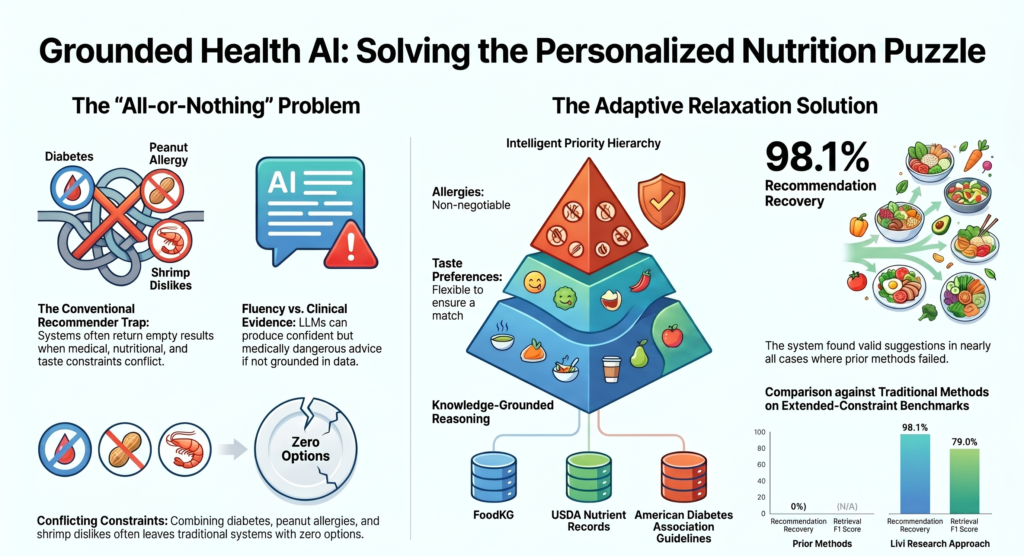
Personalized nutrition is fundamentally a constraint problem. A single recommendation has to satisfy medical guidelines, nutritional targets, and personal taste, all at the same time. Most systems treat every one of those constraints as equally rigid. So when someone has diabetes, a peanut allergy, a high-protein goal, and a dislike of shrimp, the system looks for a food that satisfies all of it at once, and frequently finds nothing. It returns an empty result, and the person gets no help.
That all-or-nothing behavior is exactly where conventional recommenders fall apart in the real world, because real people are complicated and their constraints conflict.
Teaching the model which rules matter
Our team’s paper, Adaptive Constraint Relaxation in Personalized Nutrition Recommendations: An LLM-Driven Knowledge Graph Retrieval Approach, published in the AMIA 2025 proceedings, takes a different route. The core idea is both simple and very human: not all constraints are equal. An allergy is non-negotiable. A doctor’s carbohydrate range sits just behind it. A preference for avocado over shrimp is nice to honor but safe to bend.
The system uses an LLM to read a request and assign every constraint a priority level, then grounds its search in FoodKG, a knowledge graph built from roughly a million recipes, USDA nutrient records, and clinical guidelines from the American Diabetes Association. When a fully constrained query returns nothing, the system doesn’t give up. It relaxes the lowest-priority constraints first, one careful step at a time, and stops the moment it finds a recommendation that still respects every critical requirement.
The outcome is concrete. In the paper’s running example, a diabetic user with a peanut allergy gets a real suggestion that honors their medical needs, even though a taste preference had to flex to get there.
The numbers, and the number that matters more
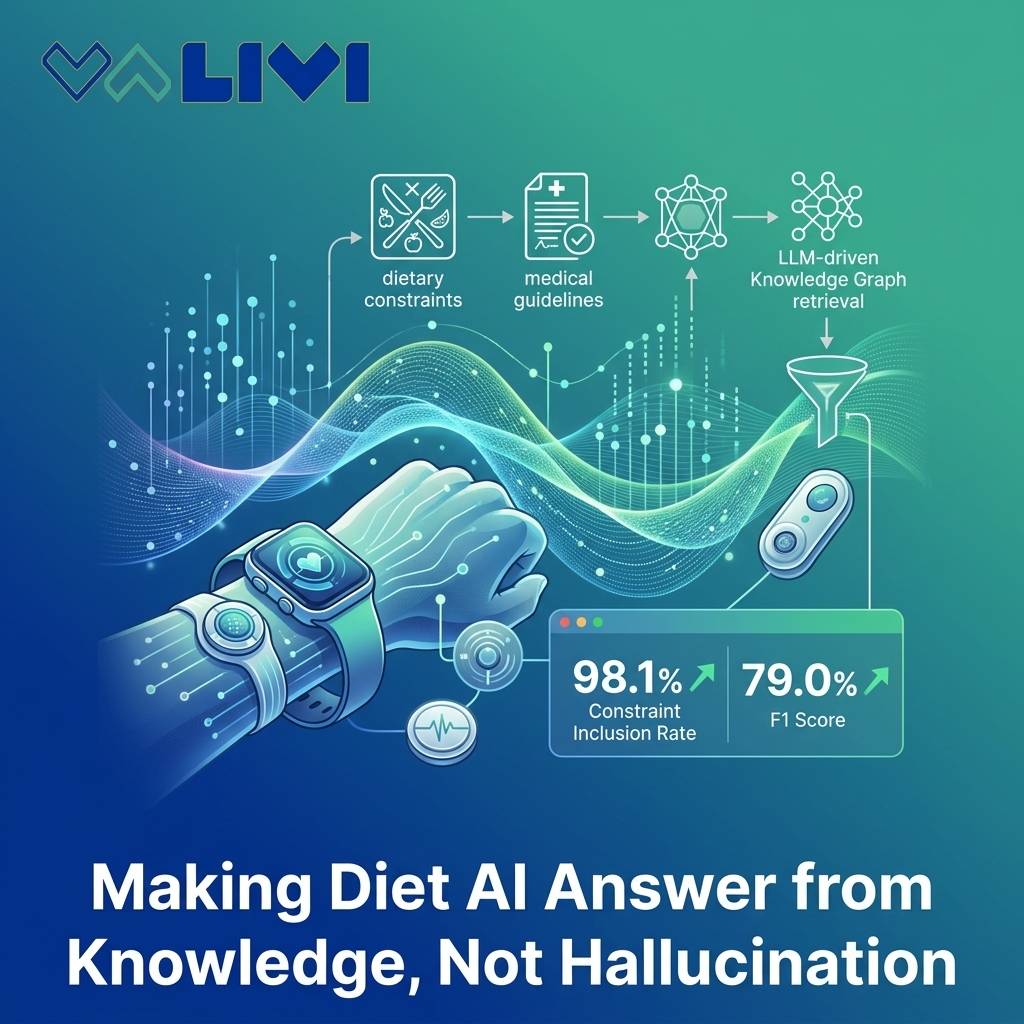
On an extended-constraint benchmark where every prior method returned nothing, the approach recovered recommendations in 98.1% of cases while keeping an F1 score of 79.0% on successful retrievals. The base retrieval module also outperformed strong baselines by a wide margin on standard precision, recall, and F1 metrics.
The number we care about most, though, is harder to put on a chart: the system stays grounded. Every recommendation traces back to structured knowledge and clinical guidelines rather than to whatever the model felt like generating in the moment. Relaxing a low-priority preference is a deliberate, traceable decision, not a hallucination dressed up as advice.
Why this is core to Livi
Livi is an agentic health AI built on the open-source openCHA framework. The design philosophy behind it is the same one driving this research: reasoning is most useful when it is anchored to evidence. An agent that can search a knowledge graph, respect clinical guidelines, and reason about which constraints are safe to relax is an agent you can actually trust to give health guidance.
This work is part of our R&D pipeline, not a side project. It reflects how we think about building Livi: pairing the flexibility of LLM reasoning with the rigor of structured, evidence-based knowledge, so that the answer a person gets is both personalized and defensible.
Fluency alone is cheap. Grounded, evidence-based reasoning is the part worth building.
Source: https://pmc.ncbi.nlm.nih.gov/articles/PMC12919543/
The research was conducted by Pengfei Zhang, Mohbat Fnu, Yutong Song, Oshani Seneviratne, Zhongqi Yang, Iman Azimi, and Amir M. Rahmani at UC Irvine and Rensselaer Polytechnic Institute. Code is publicly available.