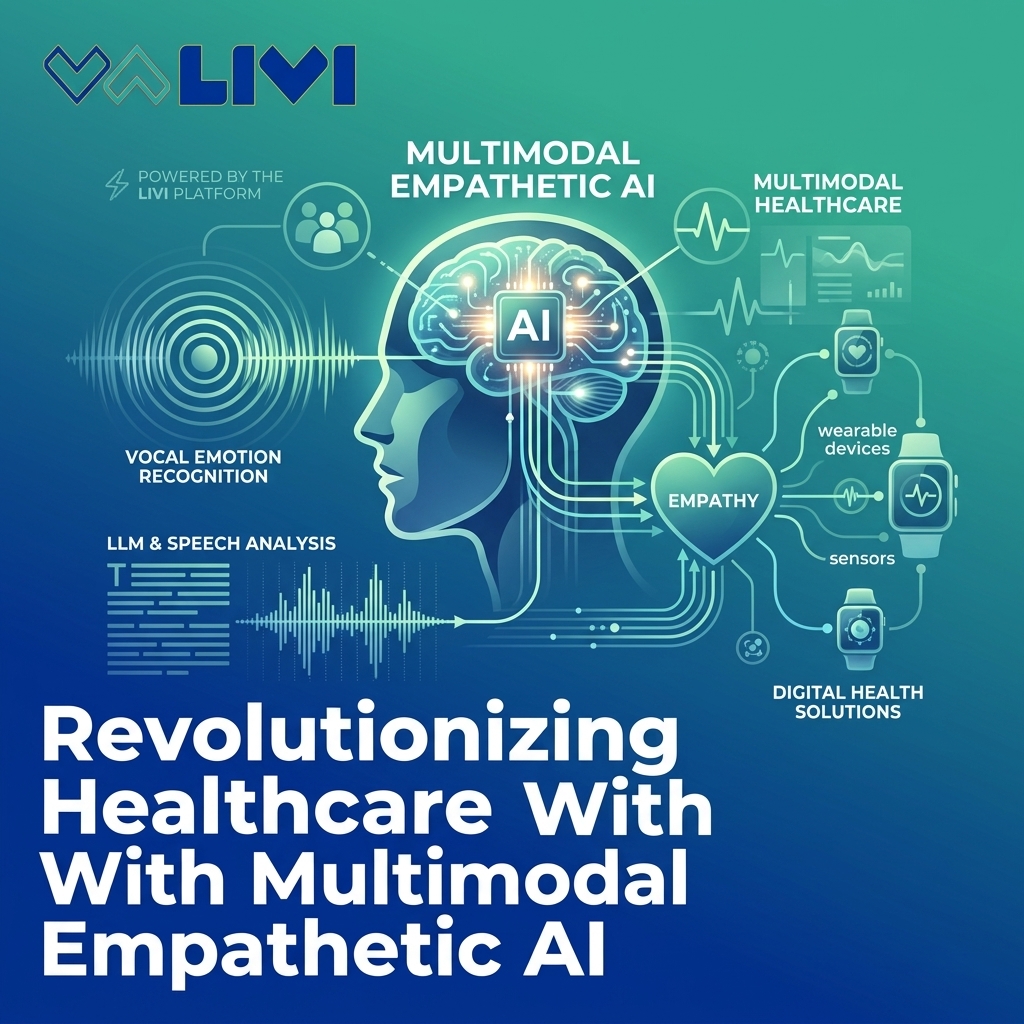
As digital health solutions evolve, the limitations of text-only AI interactions become increasingly apparent. Recent research introduces a breakthrough in human-computer interaction: an LLM-powered Conversational Health Agent (CHA) capable of understanding and responding to human emotions through vocal cues.
Methodology
The research team developed a multimodal CHA framework utilizing state-of-the-art tools, including speech-to-text models, GPT-3.5-turbo for orchestration, and a fine-tuned wav2vec2 model for Speech Emotion Recognition. By testing the AI with prompts reflecting sadness, anger, and joy, the researchers evaluated the system’s ability to plan actions and generate emotionally resonant, context-aware responses.
Findings
The results were highly promising. The system’s planning module achieved 89% accuracy in identifying emotional states from voice data and retrieving relevant information. Furthermore, human evaluators confirmed that the AI’s responses aligned well with user emotions, noting that responses to “sad” prompts were perceived as particularly empathetic and supportive.
Impact on Digital Health
This study demonstrates that integrating multimodal sensory data—specifically vocal emotional cues—enables digital assistants to offer genuine relational engagement. By breaking the text-centric barrier, AI can now provide personalized, compassionate mental health support that closely mirrors human caregivers.
Authors: Mahyar Abbasian, Iman Azimi, Mohammad Feli, Amir M. Rahmani, Ramesh Jain
This research was powered by the Livi Platform.
Read the full paper here: https://arxiv.org/abs/2405.04777?#
Join our network for deeper insights: https://newsletter.livi.health/signup