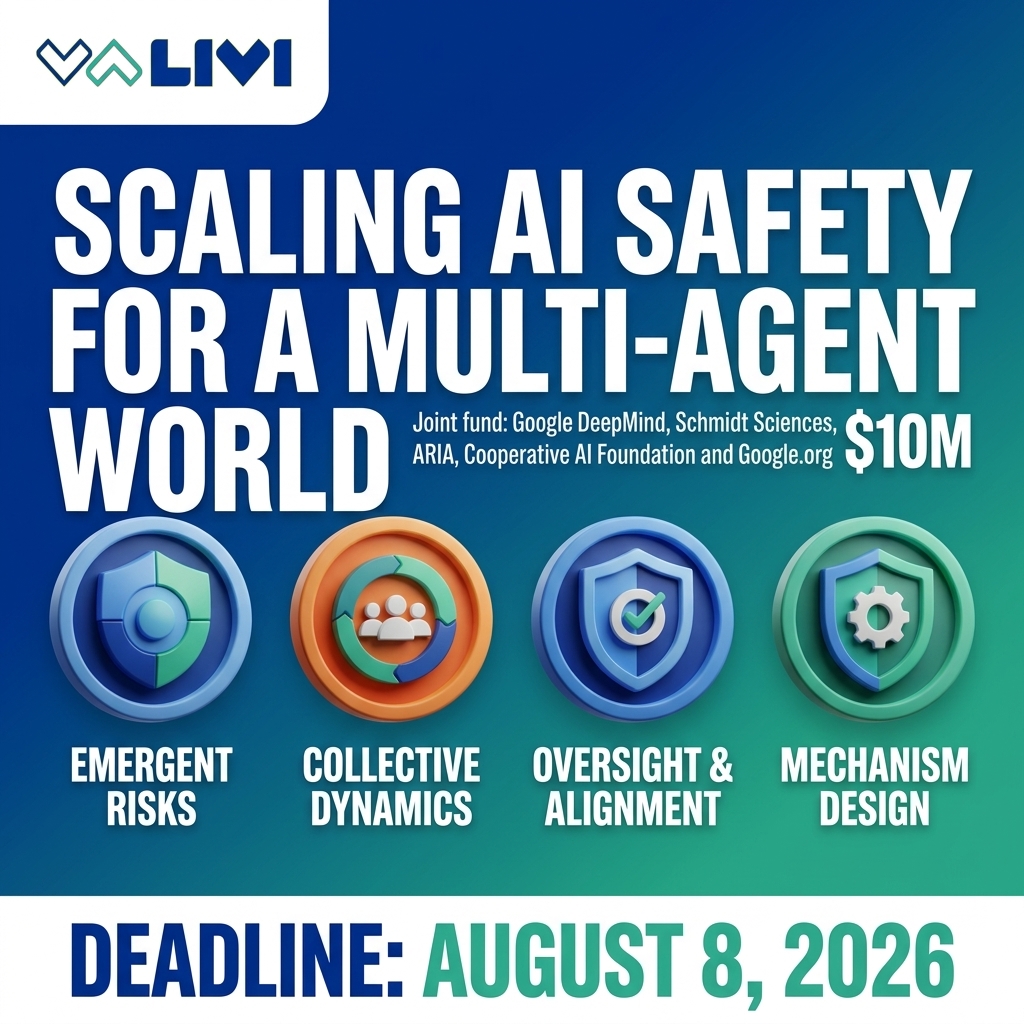
A new philanthropic funding call wants to answer one of the most pressing questions in AI safety: how do we keep millions of interacting AI agents safe when they are built and deployed by many different actors? The call, Scaling AI Safety for a Multi-Agent World, is offering up to $1,000,000 per project, with proposals due August 8, 2026.
What the call is about
AI agents are increasingly deployed alongside one another. Most setups today involve a team of agents run by a single actor, but we are starting to see something more complicated: ecosystems of agents built and operated by many different parties, all sharing the same digital infrastructure. These multi-principal, multi-agent interactions open up real opportunities for cooperation, but they also create new risks. Focusing only on the safety of individual models is no longer enough.
This call funds the foundational research needed to understand, evaluate, and control the risks that emerge from large-scale networks of interacting agents. The organizers are explicit that markets will solve some of these problems on their own. The goal here is to fund the work that would otherwise fall through the gaps.
Who is behind it
It is a joint call from five organizations: Schmidt Sciences, Google DeepMind, the Advanced Research & Invention Agency (ARIA), the Cooperative AI Foundation, and Google.org.
The four research clusters
The agenda is organized into four areas. Later clusters tend to build on earlier ones, and the organizers say they will prioritize depth over breadth.
- Sandboxes and Testbeds. Realistic, reproducible environments where populations of frontier-model agents can interact over time with real tools, memory, economic constraints, and communication channels. The organizers stress this as the key bottleneck, since progress everywhere else is hard to measure without it.
- The Science of Agent Networks. Understanding how the traits of individual agents add up to system-level behavior, how networks fail or become volatile, and how to detect dangerous collective properties, including cases where a group of agents starts behaving like a single “collective agent.”
- Strengthening Agent Infrastructure. Stress-testing and improving the technical building blocks that trustworthy agent interaction depends on: identity, verifiable attributes, reputation, accountability, commitments, and delegation.
- Multi-Agent Oversight and Control. Methods to detect, attribute, discourage, and control unsafe behavior across deployed agent populations, robust to partial observability and to the reality that no single party controls all the agents.
Funding and eligibility
- Tier 1: up to $300,000 (1 to 2 years), for exploratory projects, pilots, and focused technical investigations.
- Tier 2: $300,000 to $1,000,000 (1 to 2 years), for more ambitious or collaborative work.
Applicants may apply to either tier or both. The call is open globally to individual researchers, teams, research institutions, and multi-institution collaborations across universities, national labs, institutes, and nonprofit research organizations. For Schmidt Sciences projects, indirect costs must be at or below 10%.
What is out of scope
The call is deliberately focused. Single-agent safety, pure capability advancement, work that relies on one privileged controller for all agents, AI for human cooperation, policy-only contributions, and toy systems that do not engage with realistic frontier-model agents are all out of scope. The emphasis throughout is technical, system-level, and genuinely multi-principal.
Key dates and how to apply
- Proposal deadline: August 8, 2026, 11:59pm Anywhere on Earth
- Notification: Autumn 2026
- Informational webinars: Tuesday, June 30 (12pm ET) and Thursday, July 23 (10am ET)
- Contact: multiagentsafety@schmidtsciences.org
Full details and the application portal are available on the Schmidt Sciences program page.